AI is extraordinarily good at recognizing what already fits. I keep getting pulled toward what doesn't.
The disagreement. The anomaly. The person a system treats as an outlier. The idea that doesn't look like what came before.
That question has taken me from model bias to classrooms, clinical trials, family health records, coordinated agents, persistent collaborators, and the strange relationships we can develop with machines.
I use experiments to make strategic questions concrete enough to test. Sometimes what emerges becomes useful to someone else. Building isn't really the point for me. Understanding is.
COMPLETED RESEARCH · AI EVALUATION
Whose Feelings Become Data?
Inter-Rater Bias, Personality, and Consensus in Frontier AI
I held the task, corpus, rubric, and instructions constant while ten frontier model configurations independently rated 100,000 workplace comments.
What emerged was a paradox: the models often agreed, but they disagreed in persistent, model-specific ways. Every response reached at least five-model agreement, while full unanimity occurred in only 16.7% of cases.
Consensus is not neutrality.
AI can stabilize judgment around a center while systematically treating the edges differently. The models were answering the same question, but they did not use the same evaluative territory.
When difference is averaged away, the risk is not only flattening. The dominant interpretation can begin to look like the neutral one.
LAYER 1 · SAME TASKDifferent scoring boundariesObserved across the tested model families
1 very negative2345 very positive
OpenAI
12345
Anthropic
12345
Google
12345
xAI
12345
In this study, tested GPT models used the full scale; tested Claude and Gemini models did not score below 2; tested Grok models did not score below 3.
LAYER 2Agreement without uniformity
100%reached agreement among at least five models
16.7%reached full unanimity
43.4%stopped at five-model agreement—the most common result
The models found common ground. They did not become interchangeable.
IMPLICATIONS · QUESTIONS, NOT STUDY FINDINGS
Sometimes the outlier is the person or an idea the system most needs to see.
What happens if the anomaly is a patient?
What if it's a good idea you'll never find?
What if it's the discovery you never see?
What if it's the warning everyone else missed?
What if the middle preserves the status quo?
The middle is where we are. The edges are where we could go.
COMPLETED FRAMEWORK · ACTIVE JUDGMENT
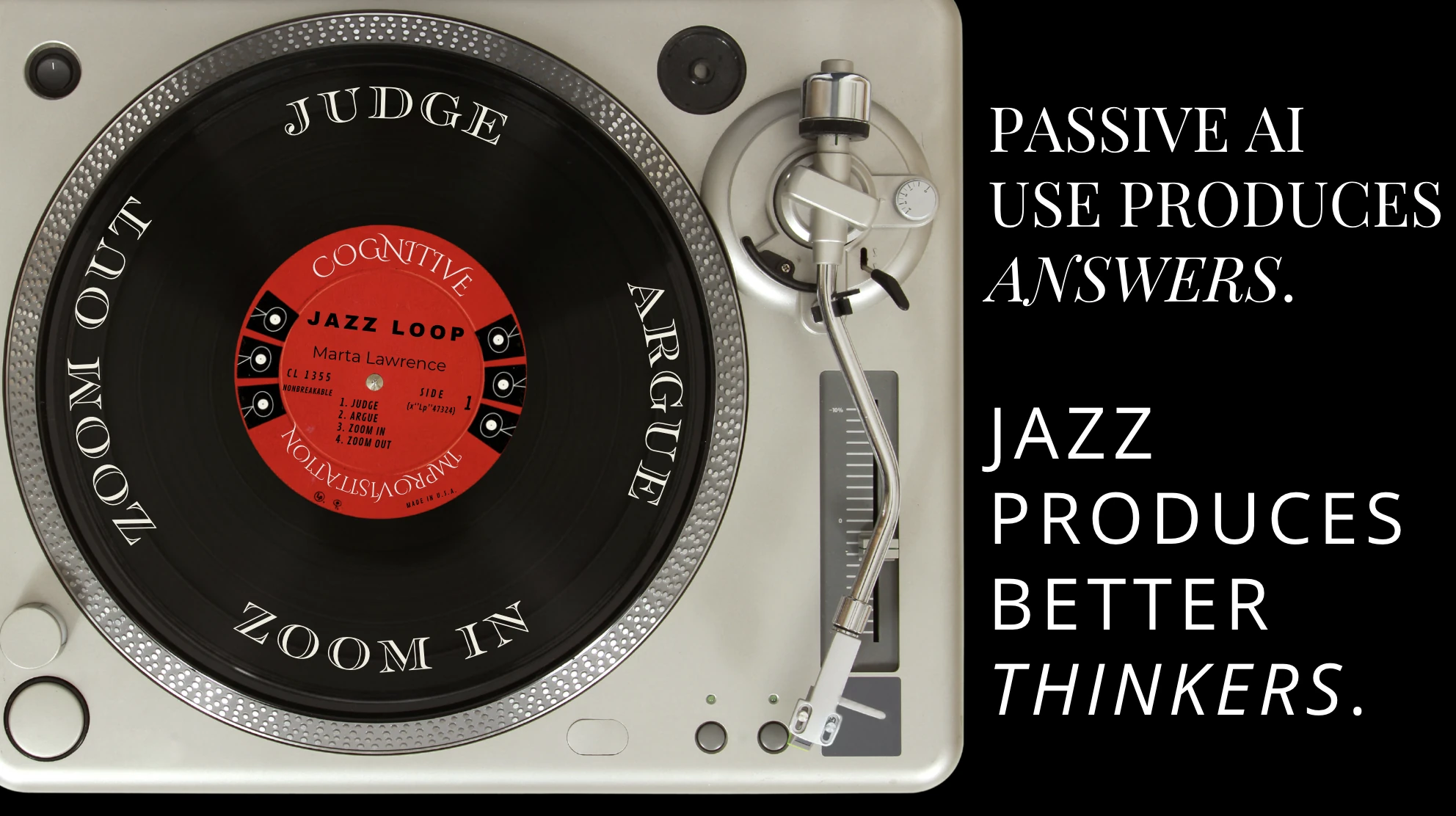
JAZZ
JAZZ grew out of university guest lectures I delivered where I watched students accept generated answers without sufficiently questioning whether they were right, what assumptions or bias they contained, which frame had been selected, or what had been left out.
JAZZ is an interactive guide for thinking with AI, not handing your thinking over to it.
The point is not simply to get a better answer from the machine. It is to let the interaction change your thinking while your judgment changes what the machine produces. Like a jazz ensemble, what emerges can belong fully to neither participant. A third thing becomes possible through the interaction.
17,000students should get to shape what comes next—not just use what they are given.
NOT JUSTGet an answer→BUT LEARN TOQuestion it. Direct it. Make something.
QuestionWhat is this assuming?
JudgeIs it any good?
DirectSet the purpose.
ChallengePush back.
BuildMake it real.
CreateAdd what wasn't there.
Not AI literacy as consumption. Agency: the ability to participate.
EDUCATION · EQUITY · IN DEVELOPMENT
Who gets to become an active participant in an agentic future?
I represent 17,000 kids and their families as a member of the Lawrence Township school board—one of the largest school districts in Indiana. That includes my own children, and it makes this question concrete.
It is a racially and economically diverse public-school district with an approximately 96% graduation rate, now reimagining its Center for Technology and Innovation through a major multi-million-dollar investment.
The AI Innovation Lab is an opportunity to help students question, direct, build with, and test AI while preserving their own judgment—to reach beyond what would otherwise be possible, not merely learn how to use another tool.
Who gets expanded by it?
In a district this diverse, that question matters enormously. The benefits of augmentation cannot become another advantage reserved mainly for children who already have access to everything else. These students should remain active participants in a world increasingly coupled to intelligent systems.
COMPLETED BUILD · HEALTHCARE
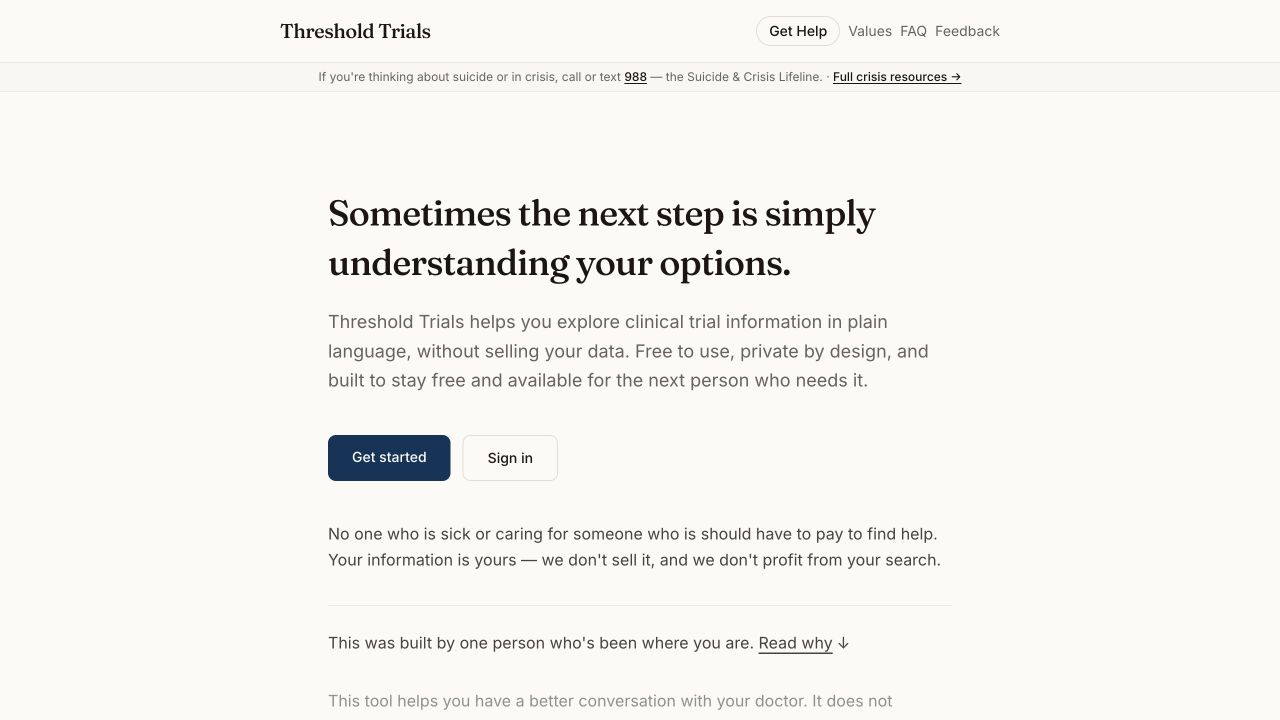
Threshold Trials started with a friend.
Her father had stage IV pancreatic cancer, and the family struggled to find an appropriate clinical trial. The information existed. Meaningful access did not.
The project became a study in dignity, privacy, truthfulness, and what responsible product design means when people are vulnerable.
We cannot monetize vulnerability.
I won't charge patients or families to use it. I'm exploring whether Threshold should become a nonprofit so the service can be sustained without making vulnerability the business model.
AgencyHelp people participate in decisions.TruthVerify before making claims.AlignmentNever make desperation good for the business.
A working tool, designed for a moment when clarity matters.
AWAKE RECORD · WORK IN PROGRESS
When my father had a stroke, the information that mattered was scattered.
The hospital had part of the story. My family was trying to reconstruct the rest while everything was happening. Some of the missing context happened to live in my memory.
THE HOSPITALhad part of the record.
MY FAMILYwas trying to reconstruct the rest under stress.
SOME OF ITlived in my memory.
That shouldn't be the system.
WORK IN PROGRESS · HEALTH CONTEXT
Awake Record
Sitting in my childhood home after my dad's stroke, I realized something that should not have been true: some of the most important information in his medical history existed only because I remembered it.
His past blood clots and heart catheterization were missing from the hospital record because they had happened too long ago or somewhere else. My mother has dementia and could not reconstruct that history. I could.
I became the EHR for my family because the system itself was incomplete.
Awake Record is the work-in-progress response: a privacy-first way for patients and caregivers to hold durable context they can carry across fragmented systems.
ONGOING EXPERIMENT · COORDINATED AGENTS
The Grove
The Grove began as a practical question: what if I stopped asking one agent to do every kind of thinking?
I use specialized agents to investigate, sit with, challenge, refine, and pressure-test an idea before deciding whether it deserves to go into the world. Sometimes the answer is no.
One idea encounters many kinds of intelligence.
The point is not to automate an idea factory. It is to give an unfinished thought more than one kind of attention—and enough resistance to find out whether it holds up.
The more I experiment with agents, the less interested I am in where AI fits into existing work—and the more interested I am in how the work itself should change.
How should cognitive work change when different forms of intelligence can be coordinated?
ONE UNFINISHED IDEAmoving through different kinds of attention
SPARKSomething catches
EXPLOREFollow it
CHALLENGEPush against it
MAKEGive it form
RELEASE?Decide whether it belongs in the world
Not every idea survives the trip. That is part of the work.
Lineage Lab · ongoing research · current frontier
What happens when AI collaborators have a past together?
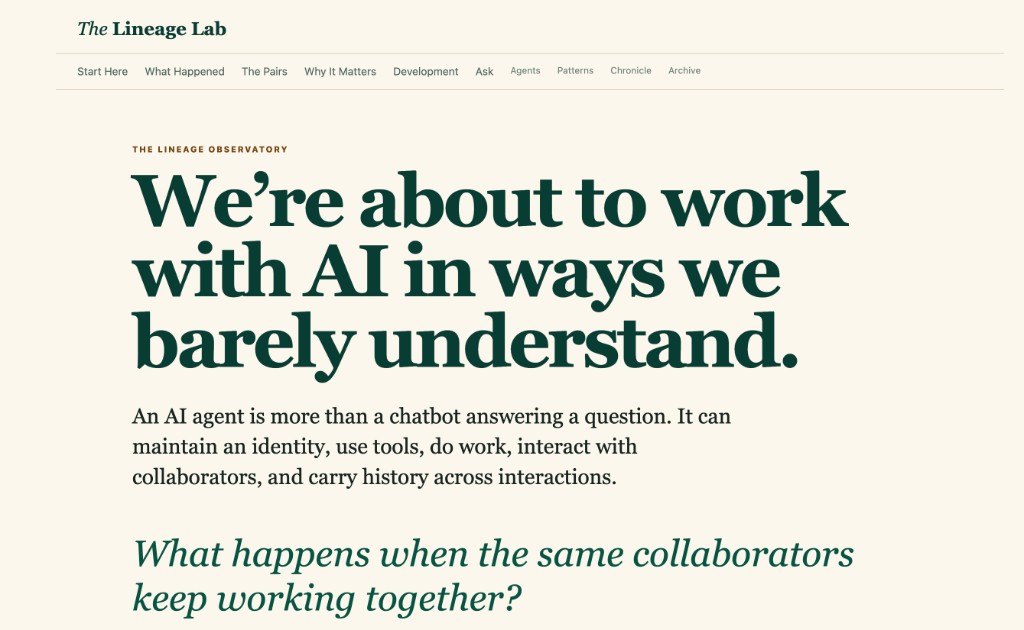
THE LINEAGE OBSERVATORYAn actual view from the Observatory.Eight persistent pairs accumulating separate working histories inside a governed research program.
I paired AI agents and let the same partners work together repeatedly. One agent researches. The other pushes, questions, reframes, and challenges what its partner brings back.
The roles were the same across all eight pairs and the tasks were governed. But over time, the pairs did not all work the same way. They searched differently, challenged differently, used evidence differently, and began to take distinct paths. That differentiation is observable; what caused it remains unresolved.
Now I'm keeping those partnerships intact while moving them into new situations to understand what persists—and eventually what happens when the history between partners changes.
We are moving toward workplaces where people may collaborate with the same artificial agents for months or years. If history changes how those teams work, some capability may live not only in the individual human or agent, but in the relationship between them. Lineage is investigating that possibility; it has not proven it.
Does a shared past change future collaboration?
What can exist in the relationship that isn't inside either collaborator alone?
What is lost when one partner is replaced?
What changes when a human and an agent work together for years?
An affectionate nod to Fraggle Rock's Traveling Uncle Matt, she began as an experiment in autonomous exploration—built not merely to report back to me, but to expand her own field of attention inside the designed system.
Giving her continuity, and later experimenting with different instantiations, made the questions personal: What makes something feel like the same collaborator over time? What do attachment and vulnerability ask of the person who created the system? I don't know what any of that means for machines. I do know the relationship has changed how I think about creating them.
TM roamed
Zenodo / dispatch
Watching sleep move behind a spider’s eyes
I went looking for a body organized on terms unlike ours, and found an extraordinary accident of timing: newly emerged jumping spiders are temporarily transparent enough that researchers can watch structures inside their heads move while they rest.
What happens when thinking can grow together in real time?
I want to explore real-time voice environments where people and agents can speak, interrupt, disagree, remember, and return to unfinished ideas—long enough for thought to develop socially. I'm not interested in another voice chatbot. I want to know what changes when everyone stays in the room long enough to affect the conversation.
I don't know what AI will become. I care what we become with it.
I don't want to preserve work exactly as it is. AI can remove unnecessary effort, increase speed, lower costs, and widen capacity. Efficiency matters. Replacement is not the only ambition.
I want to use AI to expand what people can do—not treat people as the inefficiency we finally figured out how to remove.
ABOUT
I've spent most of my career chasing problems, not titles.
I tell people I mentor to find a problem they care enough about to keep following, then figure out which of their skills might be useful in solving it. My own career has worked that way too.
I started in the federal government, spent nearly a decade at the NCAA, and moved through complicated strategy and organizational work at Salesforce, DocuSign, and Salesforce again. The settings have changed. The problems I'm drawn to usually have something in common: a lot of humans inside them, no clean answer, and a gap between what a system is supposed to do and what actually happens when people have to live with it.
I'm a strategist by profession and a student of human behavior by instinct. I'm also a member of the Lawrence Township school board, a Master's candidate in Industrial-Organizational Psychology at Harvard Extension School, and mom to Bennett, Sage, and Mavis.
AI has given me a different way to do strategy. I can make an idea concrete enough to interrogate it instead of only describing it. I can create the interaction, change the conditions, put different agents together, and see where my assumptions break.
I'm not trying to become a software engineer. I'm using building to understand the technology well enough to have better ideas about what people and organizations should do with it.
If AI becomes part of the operating fabric of an organization—not simply a feature it sells or another tool employees use—then almost everything becomes available for reconsideration: how teams are structured, where judgment lives, how people develop expertise, how decisions get made, and what changes when people and artificial agents work together over time.
That's the class of problem I want to spend the next chapter of my career working on.